
Generative AI: the time for maturity

A story – known to the general public – that is less than five years old…
Recently, companies have begun to take real and serious interest in it

2022

1M | Discovery by the general public
November 2022 — Launch of ChatGPT (GPT-3.5) by OpenAI.

2023

100M | Industrial adoption
Numerous players (Google, Meta, Microsoft, and Anthropic) launch their own large-scale models.

2024

300M | Market structuring
Claude 3.5 (Anthropic), Gemini 2.0 (Google) and GPT-4o (OpenAI) and the emergence of compelling text-to-video models (Sora).

2025

800M | Initial assessments of POCs launched in companies
September 2025: publication of an MIT study stating that 95% of POCs do not scale November 2025: publication of the first studies in the US assessing the impact on employment.

2026

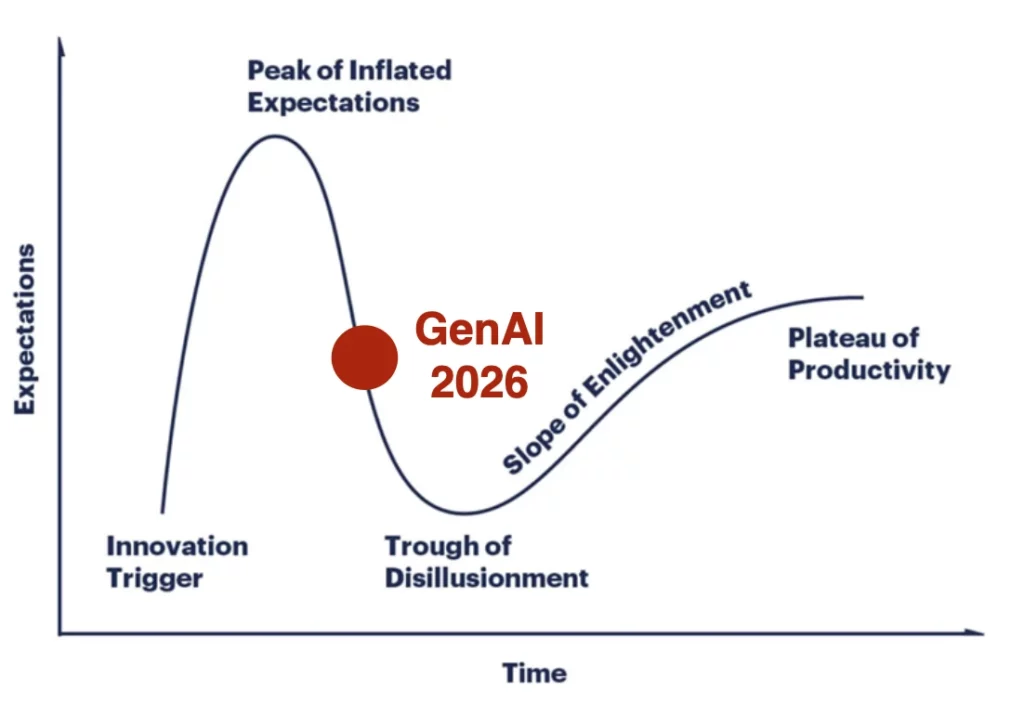
>1Bn | Questions about the sustainability and ROI of announced investments ($500 billion - Source: JP Morgan)
Companies structure their governance, attempt to control "shadow IT" and move towards vertical models.

Deployment curve of new technologies (Gartner)
xM: ChatGPT users

How can we scale up and address business processes for sustainable profitability gains?

Proven uses revolve around “office AI” (horizontal approach) with real but diffuse gains.

Survey of 150 wealth management advisers on their use of generative AI in the office.

Inform me about technical topics
70%
Summarise documents
43%
Monitor legal or regulatory developments
37%
Prepare a presentation
32%
Translate documents
32%
Conduct market research
20%
Produce reporting materials
16%
Generate reports
16%
Prepare a brief for third parties
16%
Drafting a contract
12%
Prepare financial modelling
3%

Source: survey of 150 CGPs, autumn 2025 – Mister AI.
Percentages refer to the number of citations (multiple citations possible)

Average gain: 40 minutes per day
(i.e. +8% productivity)

40 to 60 minutes per day
Gain reported by ChatGPT on its installed base

Use cases in workplace and real estate.

UPSIDE approaches generative AI through business expertise (vertical approach) by targeting pain points that can be addressed quickly.

Provide unique, natural language access to scattered information

Pain Point: Implement a search engine that breaks down organisational silos within a 500-person property management department (covering the whole of France).

Technology: ChatGPT™ 4.5

Timeframe: 4 weeks

Knowing how to process large numbers of non-standardised and poorly scanned documents

Pain Point: import leases, amendments and receipts to summarise them, display them in a structured manner and compare rent from the lease and receipts.

Technology: ChatGPT™ 5.2 x Gemini™

Timeframe: 8 weeks

Standardise and enrich PDF sources for dynamic viewing

Pain Point: centralising descriptions of diverse buildings in a portal in order to provide dynamic, enriched maps of office space listings.

Technology: Chat GPT™ 5.1

Timeframe: 6 weeks

Generating high-quality images without expertise in prompting

Pain Point: producing mood boards by type of space (open-plan, individual offices, cafeteria) using easy-to-use prompts (keywords and sliders).

Technology: MidJourney®

Timeframe: 6 weeks

Automate data processing and refine user interfaces

Pain Point: integrating data from multiple sources to feed into the CSR scorecards for a major user's office property portfolio (multilingual reporting).

Technology: ChatGPT™ 5.2

Timeframe: 8 weeks

Manage a rich repository, allowing exports in all types of formats

Pain Point: managing a repository of furniture and materials, feeding into a design charter and defining standard spaces (prices, technical data and CSR).

Technology: Chat GPT™ 5.1

Timeframe: 6 weeks

Source : real projects UPSIDE x RADIANT

UPSIDE x RADIANT.

A combined approach combining in-depth expertise in business processes and excellent capabilities in generative AI development.


Logo UPSIDE baseline

Proposed approach :
« Demo, don’t memo ! ».

Twelve weeks to identify pain points to address (time-consuming processes) and deliver a development using generative AI.

Would you like to continue this discussion?
Write to us: